Showing posts with label PA Legislative Branch. Show all posts

Monday, March 14, 2011

Gov. Corbett WAMs PA Again

By Tim Potts of Democracy Rising PA

As he allowed 42,000 working poor citizens to lose their AdultBasic health insurance for want of $54 million, Gov. Tom Corbett quietly approved $48 million in WAMs (walking around money) for lawmakers’ pet projects. He also did not ask lawmakers to give up any of their $188.5 million surplus to help balance the budget. Corbett promised as a candidate to stop WAMs and get the legislature to return all but a fraction of its surplus.

Here is the WAMs story:

Gov. Tom Corbett OKs $48 million in legislators’ grants, WAMs, Harrisburg Patriot, March 11.

Let’s make this simple.

1.  WAMs are unconstitutional. See  Common Cause of Pennsylvania v. Commonwealth, 668 A.2d 190 (1995).

The Commonwealth Court ruling, affirmed by the PA Supreme Court, said that the General Assembly may not, “…authorize, designate, allot, or set aside moneys, either directly or indirectly earmarked for specific entities not under the absolute control of the Commonwealth.”(emphasis in the original by the Court) Id. at 205. If the legislature wants to do that, the Constitution requires that each appropriation be in a separate bill that requires a two-thirds vote for passage. See Article III, Section 30.

Further, the court said that, “…such a designation would violate one of the central tenets of our system of government, separation of powers.” Id.

And, “…the legislative branch may not micro-manage the executive’s power to administer appropriated funds by earmarking the non-governmental recipients thereof.” Id.at 206.

WAMs earmark appropriated funds, after they are appropriated, for non-governmental recipients that are not under the absolute control of the Commonwealth. The funds are appropriated without separate bills that received a two-thirds vote for passage.

2.  All governors, all lawmakers, in fact all public officials, take an oath to “obey” the Constitution. See Article VI, Section 3.

The Constitution does not permit a new governor to disobey the Constitution because his predecessor did. The new governor himself is responsible for obeying the Constitution, including Common Cause of Pennsylvania v. Commonwealth.

3.  Gov. Corbett could have refused to give away $48 million in WAMs.

Every WAM requires the approval of the governor. Corbett could and should have refused to approve the WAMs because they are unconstitutional, but he didn’t.

4.  Then there are his campaign promises to the voters who elected him.

Speaking of WAMs in his response to the 2010 Integrity Questionnaire by Democracy Rising PA and Rock the Capital, Corbett said:

  • “The Office of the Governor, with the ability to blue-line legislation and control disbursements of state grants, can and will be effective in rooting out this wasteful spending under my administration.”
  • “Essentially, the governor [referring to then-Gov. Ed Rendell] has been able to preside over the willful disbursement of WAMs because his explosive spending agenda has not faced meaningful checks and balances which would accomplish the needed elimination of wasteful spending.”

Click here to read Corbett’s entire questionnaire response. Approving WAMs isn’t the only promise Corbett has broken. Another was the promise to deal with the legislature’s surplus:

“…I will work with the General Assembly to cap the legislative accounts at a fraction of its current level. The current legislative surplus should be used to help relieve the pressure created for Pennsylvania taxpayers by the increasing spending in Harrisburg.”

Gov. Corbett’s budget proposal was business as usual with the General Assembly. Here are some stories:

Lawmakers not asked to sacrifice in Corbett’s budget, KDKA TV Pittsburgh, March 9
Legislative budget barely trimmed,
Pottsville Republican-Herald, March 11
Lawmakers: Legislature should lead by example,
The Sentinel, Cumberland County, March 11
Balancing the books, then reform,
Allentown Morning Call, March 13
PA legislature’s cash bound by few rules,
Centre Daily Times, March 13

Comment:

We take no delight in reporting this news for two reasons. First, citizens had every reason to expect Gov. Corbett to live up to his promises. He spent most of a year telling us so.

Second, it doesn’t have to be this way. Other states prove it.

Questions:

  • When will our political leaders give us the highest standards of public integrity in America?
  • If they don’t, when will we elect new political leaders who will?

Please support our work with a tax-deductible contribution. They hate it when you do that.
Click here or send a donation to Democracy Rising PA, P.O. Box 618, Carlisle, PA 17013.

Thank you!


Friday, March 04, 2011

Budget Pain - Not for Lawmakers, Corbett Staff

By Tim Potts
DR News: Budget Pain: Not for Lawmakers, Corbett Staff

On the day that 42,000 working poor in PA lost their health insurance because Gov. Tom Corbett and lawmakers couldn’t find money to pay for the Adult Basic health insurance program, a Pittsburgh TV station revealed that lawmakers have their own private doctor for the General Assembly.

In addition to paying Dr. Paul Grosh $170 per hour, up to $65,000 a year, lawmakers are using tax dollars to pay Dr. Grosh’s own health insurance, dental, vision and prescription drug costs plus his medical malpractice practice premium. There is no dollar value given for the benefits or malpractice insurance costs.

Here is the report by WTAE-TV’s Jim Parsons:   Taxpayer money used for legislators’ medical treatment.   Click here  to see the contract with Dr. Grosh.

Back to the working poor, the estimated cost of continuing the Adult Basic health care program is reported to be $54 million. The surplus in legislative leaders’ accounts is $188 million.

The legislature’s own health insurance costs taxpayers $19,633 per lawmaker per year, according to a column by John Baer in the Philadelphia Daily News: Gov. Corbett: Read your mail, save the health plan.  Senators have paid 1% of wages, or about $800 per year, for their health insurance since 2007. Representatives have paid nothing but will begin paying 1% in July.

Corbett pays top staff 11% more than Rendell

On Sunday, the Pittsburgh Post-Gazette and Philadelphia Inquirer reported that Gov. Corbett is paying his top staff significantly more than former Gov. Ed Rendell, an average of $129,303 for Corbett compared to $116,440 for Rendell, an increase of 11%. Corbett’s budget axe hasn’t taken swing at staff salaries,  Pittsburgh Post-Gazette, Feb. 27.

Corbett’s office points out that he so far has hired two fewer high-level staff than Rendell so that the total spending is less.

Some in legislature have convictions

As the trial of Sen. Jane Orie, R-Allegheny, continues in Pittsburgh, one legislative staffer has joined the ranks of those sentenced for their crimes in the Bonus Scandal. Former House staffer Patrick Lavelle, Jr. was sentenced this week after pleading guilty to partisan fundraising at taxpayer expense. Lavelle, who cooperated with prosecutors, was sentenced to:

  • Serve five years probation
  • Pay $5,000 in fines
  • Pay $22,000 in restitution to taxpayers for the bonus he received for his political work
  • Perform 750 hours of community service

Lavelle worked for former Rep. Mike Veon, D-Beaver, who is currently serving a six to 14-year sentence for his role in the Bonus Scandal. Here’s the story: Bonusgate defendant PJ Lavelle, ex Veon aide, gets probation sentence,  Harrisburg Patriot, March 1

Still awaiting trial are former House Speaker Bill DeWeese, D-Greene, and former House Speaker John Perzel, R-Phila. Other former representatives who also await trial are Brett Feese, R-Lycoming, and Steve Stetler, D-York. Former senator Raphael Musto, D-Luzerne, awaits trial on federal charges unrelated to the Bonus Scandal, and former Sen. Robert Mellow, D-Lackawanna, is the target of another federal grand jury investigation.

Speaking of the Orie trial, jury deliberations were halted today when prosecutors alleged that key defense documents were altered. Orie trial halted over allegation of doctored documents,  Pittsburgh Post-Gazette, March 3. Click here  to see the documents in question.

If we lived in other states…

Common Cause PA’s Barry Kauffman points out that if Sen. President Pro Tempore Joseph Scarnati, R-Jefferson, and Sen. Tim Solobay, D-Washington, lived in any of 35 other states, they could be facing criminal charges today. The two are among an unknown number of lawmakers treated to the Super Bowl by Consol Energy, a leading energy firm with an interest in Marcellus shale drilling and extraction. Here are two stories:

Perks from PA drilling interests,  The Philadelphia Inquirer, Feb. 13
Scarnati to pay back shale company for Super Bowl junket,
 The Philadelphia Inquirer, Feb. 14

Two-thirds of PA voters want to prohibit public officials, not just legislators, from taking gifts from lobbyists and special interests. The other states prove it can be done.

Questions:

  • Why can’t PA ban gifts as many other states have done and PA voters want to do?
  • Why isn’t pushing public integrity a priority for the governor and legislative leaders?
  • Why isn’t the generous package of salary and benefits that taxpayers provide enough for these people?

Please support our work with a tax-deductible contribution. Click here  or send a donation to Democracy Rising PA, P.O. Box 618, Carlisle, PA 17013.

Thank you!


Monday, February 28, 2011

March 1st Press Conference in Harrisburg Introducing State Immigration Enforcement Package

March 1st Press Conference Introducing State Immigration Enforcement Package

Although this is not a NumbersUSA event, information is being forwarded to members in Pennsylvania who may be interested in attending or watching the live web cast.

Dear Pennsylvania activist,

The message below is from Rep. Daryl Metcalfe, a champion of state immigration enforcement legislation, who will hold a press conference on Tuesday, March 1st to introduce a package of enforcement bills for the 2011 session. He is encouraging those who live in the Harrisburg area to attend the event. You also may watch the live web cast.

Within the next few days, we will forward more information on his package of bills and ask you to contact your state legislators about becoming bill co-sponsors.

------

MEDIA ADVISORY

State Lawmakers to Deliver Solution to Halt Pennsylvania’s Illegal Alien Invasion

WHAT:    State Representative Daryl Metcalfe (R-Butler) and other prime sponsors will officially introduce the National Security Begins at Home illegal immigration reform package for the 2011-12 legislative session.                               

WHO:   Other invited speakers include: Reps. Jim Cox (R-Berks), Tom Creighton (R-Lancaster), Rob Kauffman (R-Cumberland/Franklin), Jerry Knowles (R-Berks/Schuylkill), Ron Marsico (R-Dauphin), Mark Mustio (R-Allegheny), Scott Perry (R-Cumberland/York), Harry Readshaw (D-Allegheny) and Sen.  Kim Ward (R-Westmoreland).                

WHEN:       Tuesday, March 1, 2011

TIME:        10 a.m.

WHERE:    State Capitol Media Center, Harrisburg

LIVE WEB CAST:   Log on to RepMetcalfe.com, beginning at 9:55 a.m. on Tuesday morning.
Email from:
Numbers USA
1601 N. Kent Street
Suite 1100
Arlington, VA 22209


Thursday, January 06, 2011

What a Difference a Day Makes

By Tim Potts

The PA House of Representatives this week showed a bipartisan attitude toward improving public integrity for the first time since the Pay Raise of 2005. While neither party can claim to advocate the highest standards of public integrity in America for PA citizens, House Republican leaders since 2009 have put forward ideas while the then-majority House Democratic leaders put forward nothing but rhetoric. That changed with Tuesday’s adoption of some new rules, but by Wednesday the new bipartisan machinery stalled when it came time to adopt new policies.

Tuesday’s rules. The House Democrats’ new leadership joined with the new Republican majority’s leadership to begin making changes that integrity advocates have long wanted. House Resolution 1, the 44-page document that establishes the rules the House should follow for the next two years, includes changes to:

  • Clarify that using tax-funded time, space and facilities for partisan political campaigns is prohibited. This reinforces state law that already makes such activity illegal.
  • Prohibit lawmakers from donating expense reimbursements to charities. It has become common for lawmakers to make such donations, and get tax deductions, when challenged about accepting per diems and their annual COLA.
  • Prohibit mass emails within 60 days of an election. The old rules prohibited only paper mailings.
  • Streamline ceremonial resolutions by allowing a single vote, instead of separate votes, on any number of non-controversial resolutions.

Of course, it’s hard to be satisfied with rules changes. In House rule more of same (Jan. 5) the Scranton Times-Tribune points out the long history in the House and Senate of refusing to enforce their rules and frequently suspending them. This is why DR and other integrity advocates have called for laws, not rules, to make lasting improvements.

Wednesday’s policies. Hoping to build on the spirit of bipartisanship, Republican and Democratic leaders intended to bypass floor votes and accomplish more improvements. The plan was for the Bipartisan Management Committee of the House, consisting of the five top leaders, to adopt policies to:

  • Require members to document expenses in order to receive reimbursements through per diems. Until now, the daily allowance has amounted to a second salary because lawmakers could claim up to $163 per day for expenses that, in many cases, were entirely fictional.
  • Prohibit long-term leases of private cars. There is an exception for long-term leases arranged prior to March 2007. The House’s chief clerk will negotiate a master lease with the Department of General Services.
  • Require members to pay 1% of gross wages toward their health care. If adopted, the House would match the Senate, which adopted the same requirement in 2007.

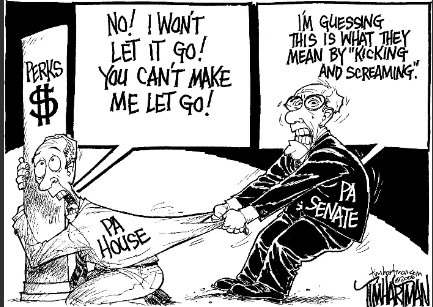
PA House Perks ManiaThat was the plan. But House leaders couldn’t pull it off yesterday, pending more negotiations. Pa. House measure to curb perks stalls out, The Philadelphia Inquirer, Jan. 6.

That gives House leaders the chance to raise the ante with the Senate on paying for health insurance. Although a long-needed step in the right direction, the health insurance contribution neither saves significant money for taxpayers nor puts lawmakers in a position to know the struggle ordinary citizens face in obtaining health insurance. The total budget impact, based on budget line items for House salaries, amounts to roughly $637,000.

For individual lawmakers, the 1% contribution amounts to about $800 per year (rounding lawmakers’ base salary to $80,000). By comparison, ordinary citizens who can afford it would pay nearly twice that amount per month for comparable coverage.

Question:

  • Will your representative encourage leadership to adopt even better changes to House policies?

Reapportionment: Testing bipartisanship. It’s hard to think of a tougher trial for a political relationship than the decennial process of re-drawing the borders of legislative districts. Even within parties, the process has been known to create life-long hostilities.

Following last year’s national census, the Legislative Reapportionment Commission this year will draw new lines for legislative districts, beginning with the election of 2012. The procedure in the PA Constitution that governs reapportionment, Article II, Section 17, is a baldly political one. Ten years ago, it produced the second most gerrymandered legislative districts in America, according to the U.S. League of Women Voters. Then, as now, Republicans controlled the House, Senate and governor’s office. Click here for an excellent report on the subject by the PA League.

One way citizens can test the new bipartisanship in the House is by the quality of the lines drawn this year.

Tonight at 8:00: WITF-TV’s “Smart Talk” will feature a segment on reapportionment, including DR’s Tim Potts. Go to www.witf.org .

Read more informative articles at Democracy Rising Pennsylvania

Thursday, April 09, 2009

Pay-to-Play

By , Co-founder Democracy Rising PA

It sounds like another form of gambling getting ready to take root in PA. But for many years it hasn't been much of a gamble for those who bankroll political campaigns, and its roots are firmly established.

Pay-to-play refers to the coincidence of campaign contributors receiving no-bid contracts from the government after their candidates win. If such arrangements were in writing, they would be illegal. But they exist in the land of Wink and Nod with no paper trail for prosecutors to assemble as evidence. Click here for Wikipedia's description of pay-to-play.

Yesterday, the Wall Street Journal reported on a specific instance of what it called the "State Lawsuit Racket" involving Gov. Ed Rendell and a law firm in Houston, TX. Click here for Wednesday's WSJ story and here for The Philadelphia Inquirer's follow-up today.
F. Kenneth Bailey, a principal in the firm of Bailey, Perrin & Bailey, made repeated donations to Rendell when he was seeking re-election in 2006. During the eight-month period from February through October 2006, the donations totaled $91,100. During the same period, Rendell, with the concurrence of Attorney General Tom Corbett, negotiated a no-bid contract with Bailey to prosecute a lawsuit by the state against a pharmaceutical manufacturer.

The story presents another one of those timelines that strain the definition of coincidence. Here it is, as presented in the WJS story (all dates are 2006):

  • February 23: Bailey contributed airplane travel valued at $9,200 to Rendell's re-election campaign.
  • March 3: Bailey contributed $50,000 to the Rendell campaign.
  • May 12: Rendell's office asked Corbett's office, which normally would represent the Commonwealth in such a lawsuit, to allow the governor's office to handle the case.
  • May 24: Corbett's office granted Rendell's request.
  • August 14: Bailey signed a no-bid contingency-fee contract with the state.
  • September 15: Bailey contributed airplane travel valued at $6,900 to Mr. Rendell's campaign.
  • October 23: the Governor's Office of General Counsel mailed the contingency fee contract to Bailey.
  • October 30: Bailey contributed another $25,000 to Rendell's campaign.

As is customary when awarding no-bid contracts, Rendell's office claims that the Texas law firm has "experience" in such matters. The pharmaceutical company has challenged the legality of Rendell's arrangement with Bailey, Perrin & Bailey. Apart from the smell test, the company contends that the Bailey contract violates the state Constitution. The matter is now before the PA Supreme Court.

Questions:

  • Why did this have to be a no-bid contract?
  • Why did Corbett's office decide not to handle this case? How many and which other cases have they allowed Rendell to pursue with outside counsel? Who got the contracts to handle those cases?
  • How is a Texas law firm better able than the attorney general to argue the interpretation of PA's Constitution?
  • In a state that is home to pharmaceutical companies, how likely is it that the experience of a Texas law firm is better than the experience of PA law firms that might have bid on the work?

A Timely Proposal
The WSJ story arrived just two days after House Republican Leader Sam Smith, R-Jefferson, announced that his caucus will propose a package of bills to improve various aspects of public integrity, including pay-to-play. Click here for the list of 12 proposals.

One of five parts in the pay-to-play proposal says, "No government contract can be awarded to a person, partnership or corporation that donated to the campaign of the state official responsible for awarding the contract within one year of the date a contract is posted for public bidding."

Question:

  • If the campaign contribution is intended to influence an election that won't occur again for a specific term of years, why not ban contracts with agencies for the full term of the officials who benefit from the contribution? (E.g. two years for contributors to representatives; four years for contributors to senators and the governor; and ten years for contributors to judicial campaigns.)

Philadelphia First?
Now here's some news that those who love to hate Philadelphia won't like: Philadelphia has taken the lead on ending pay-to-play in PA.

Three years ago, Philadelphia banned large campaign contributors from getting large city contracts. Businesses that contribute more than $10,000 to a city candidate may not get no-bid contracts worth more than $25,000. Individuals who donate more than $2,500 may not get no-bid contracts worth more than $10,000. It's still a pretty good investment, but not nearly as good as it used to be.

Click here for access to the Philadelphia Code provision. Look for Section 17-1404.

Question:

  • Will enough rural legislators be embarrassed by Philadelphia's leadership to ensure passage of a better law for PA?

Remember: Only you can keep democracy rising!
Donate here!
Thanks!

Read more at

Political